
Puffins
were my Co-workers

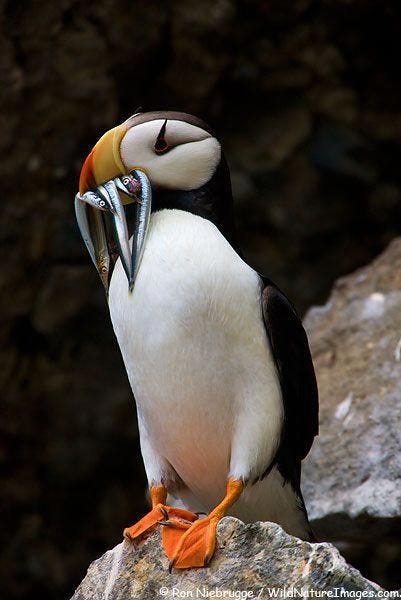
In Sitka, wildlife tour companies run trips out to Saint Lazaria Island hoping to catch views of the thousands of seabirds that nest on the island refuge. A friend of mine went on one of those tours, but didn’t see a lot, weather obscured visibility. Even in summer, Sitka Sound can be squirrely, foggy, rainy, or blowing 30 knots. Biologist estimate over half a million birds nest on the basalt island. Rocky cliffs, scoured clean by winter storms, are densely covered with bird nests, tucked onto narrow ledges. Higher on the island, ground-nesters, like puffins, have burrows. Saint Lazaria island is a whose-who of seabirds, auklets, petrels, meurres, murlets, cormorants, gulls and two kinds of puffins, tufted and horned. The tufted are black, the horned puffins look like clowns.
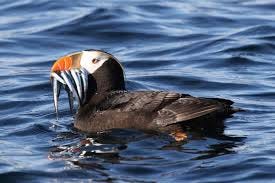
In summer, the ocean waters around the island were teeming with needlefish, a prime food source for seabirds and king salmon. On days when I fished around the island, the seabirds dove and filled their beaks with needlefish while I trolled close enough to watch the breakers. I was a guest in their world, in awe of the dramatic scenery of the rocky cliffs and bird life. Even on the calmest of days, oceans swells rose up into the thick inter-tidal zone bursting with barnacles and salty seaweed. The rest of the fleet ran out to Cape Edgecome to fish. When I didn’t feel like competing with the mass of serious boats, I stayed behind working the reef alongside the puffins. Besides, I always caught a lot of fish there.
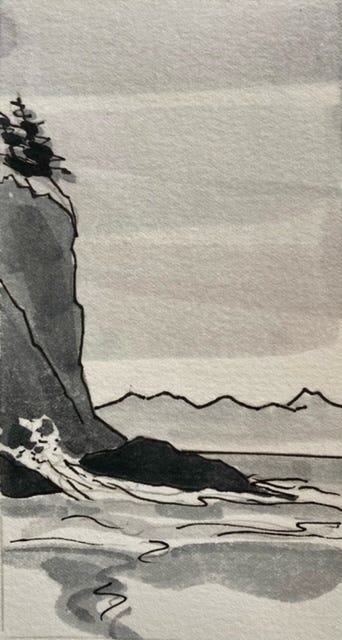
Fifty to one hundred boats sometimes anchored behind the island. It was not a great anchorage, with a slippery bottom that wouldn’t always hold an anchor from sliding around. Worse, in some places, anchors could be trapped in a basalt crack and not be pulled off the bottom. In spite of anchoring difficulties, I loved being there.
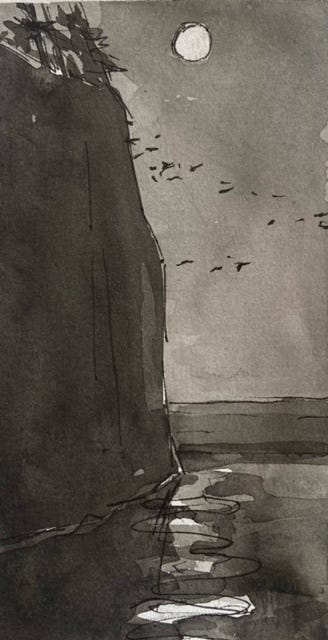
Marvel’s anchor was set and it felt secure for the night. Finally, the diesel engine was off and quiet. I sat on the hatch cover and looked at the late evening light while another boat came in behind the island. In one smooth continuous motion, his boat moved slowly in reverse while he walked to the bow and kicked his big galvanized anchor overboard. I could hear the heavy chain rattle as the anchor fell to the sea bottom. He calmly walked back into the wheelhouse and strained the engine in reverse against the anchor until the boat would not move. With his anchor set, he turned off his engine and flipped on the anchor light. The boat bounced forward and settled, anchored for the night. As his final step, he pulled out his boot liners to dry by the stove, his head hit the pillow, and he was fast asleep, from the early long day and gentle rock of the boat. Seabirds were back on their nests for the night.
.